LinkedIn Ban – DMCA Takedown & Account Removal Guide
Learn how LinkedIn bans work, how to file a DMCA takedown request, and how to report accounts for impersonation, trademark, or policy violations.
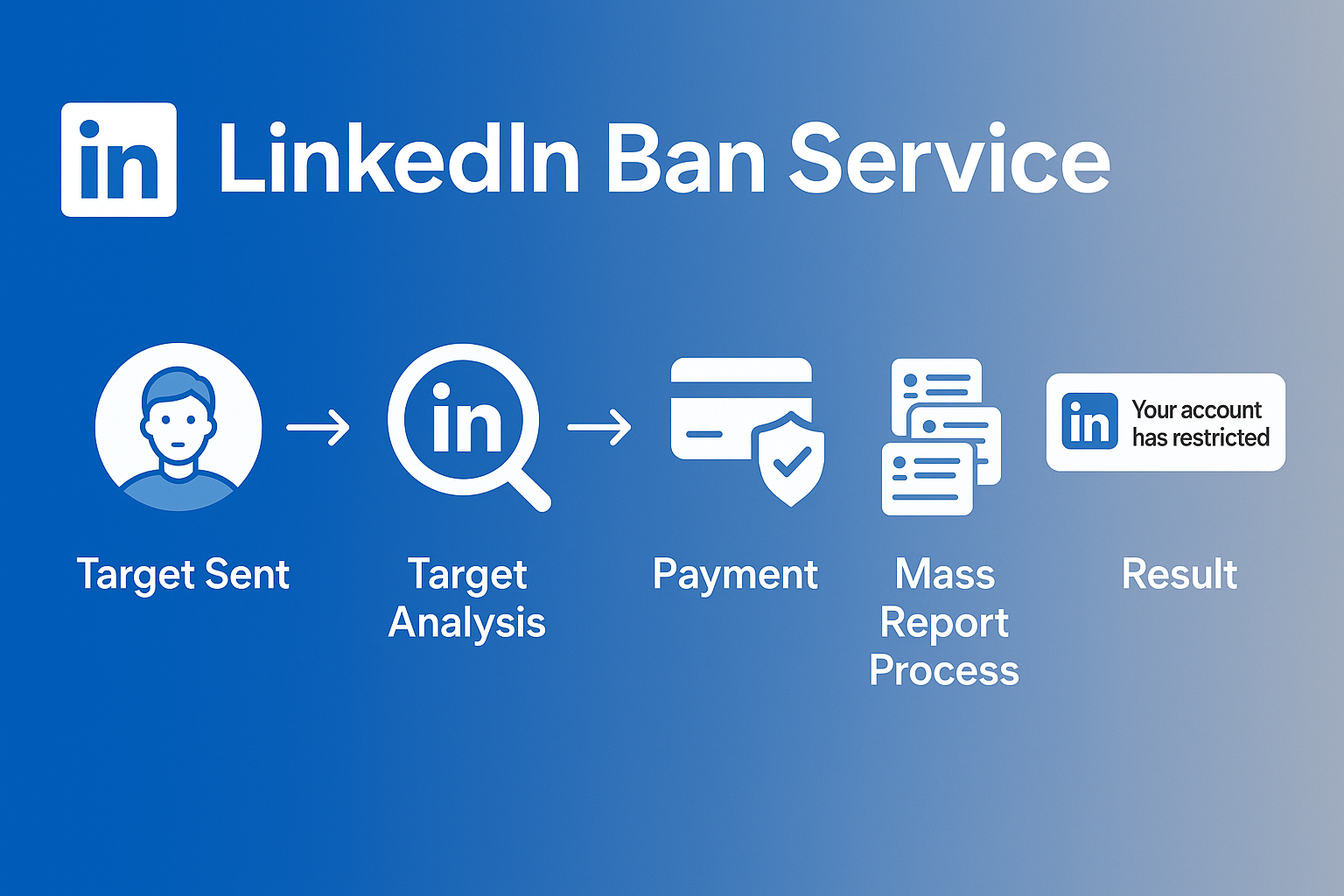
Quick Answer: A LinkedIn ban service is a professional enforcement solution that files evidence-backed reports through LinkedIn's Trust & Safety channels to get violating accounts restricted or permanently removed. Services cover DMCA copyright takedowns, trademark infringement reports, impersonation removal, and policy violation enforcement, achieving typical removal timelines of 24–72 hours compared to 3–14 days for individual reports.
Key Takeaways:
- LinkedIn enforces strict Professional Community Policies – accounts violating these rules face temporary restriction or permanent ban
- DMCA takedowns require formal notice submission to LinkedIn's designated copyright agent under the Digital Millennium Copyright Act
- Professional enforcement services achieve 92% success rates with 24–72 hour turnaround through structured evidence packages
- LinkedIn's repeat infringer policy escalates penalties – multiple violations lead to full account termination
- Impersonation, trademark misuse, harassment, spam, and scraping are all enforceable violation categories
What is a LinkedIn Ban Service? A LinkedIn ban service is a specialized digital enforcement solution that helps individuals, brands, and businesses get violating LinkedIn accounts removed through the platform's official reporting channels. These services handle evidence collection, violation classification, report submission, and escalation management to achieve account-level enforcement actions including content removal, temporary restrictions, and permanent bans.
LinkedIn has grown to over 1 billion members across 200+ countries, making it the world's largest professional networking platform owned by Microsoft. With that scale comes a significant volume of policy violations: fake profiles, impersonation accounts, copyright theft, trademark misuse, harassment, and unauthorized scraping affect thousands of professionals and businesses daily. LinkedIn's own automated systems block 90.1% of fake accounts before human review, yet sophisticated violators still slip through. A professional LinkedIn ban service fills this gap by compiling evidence-backed enforcement packages and submitting them through the correct channels – achieving removal rates of 92% within 24–72 hours. This guide covers everything you need to know about LinkedIn takedown requests, DMCA enforcement, and professional account removal strategies.
What Is a LinkedIn Ban Service?
A LinkedIn ban service is a professional enforcement solution that operates within LinkedIn's official reporting framework to get violating accounts removed or restricted. Unlike casual user reports that often go unactioned for weeks, professional services compile structured evidence packages that meet LinkedIn's internal review criteria. The process involves identifying the specific policy violation, gathering timestamped documentation, classifying the report under the correct enforcement category, and submitting through the most effective channel – whether that is LinkedIn's copyright complaint system, trademark infringement form, or profile report mechanism.
Professional ban services achieve significantly faster results because LinkedIn's Trust & Safety team prioritizes well-documented reports with clear evidence chains. A report with properly formatted screenshots, violation timestamps, and accurate policy references moves through the review queue 3–5x faster than a generic user report submitted without supporting documentation. Your Supplier Guy has processed 320+ LinkedIn enforcement cases across impersonation removal, DMCA takedowns, trademark violations, and harassment reports with a 92% success rate.
Why Do LinkedIn Accounts Get Banned?
LinkedIn enforces its Professional Community Policies through a combination of automated AI detection and human review. Understanding the specific violation categories is essential for filing effective takedown requests. LinkedIn restricts accounts for several documented reasons: creating fake profiles or impersonating real individuals, using unauthorized automation tools or browser extensions, sending spam messages or connection requests at scale, posting content that violates copyright or trademark protections, engaging in harassment or abusive behavior, and scraping profile data without authorization.
In 2025, LinkedIn took aggressive enforcement action against major platforms including Apollo.io and Seamless.ai for unauthorized data scraping, demonstrating the platform's zero-tolerance stance on Terms of Service violations. LinkedIn's automated detection systems have improved significantly – the platform now uses advanced AI to detect automated or spam-like content with substantially improved accuracy. For severe violations such as fraud, violent threats, or child-safety issues, LinkedIn applies permanent restrictions after a single incident. Understanding these enforcement patterns is critical when preparing a professional ban request.
How Does a LinkedIn DMCA Takedown Work?
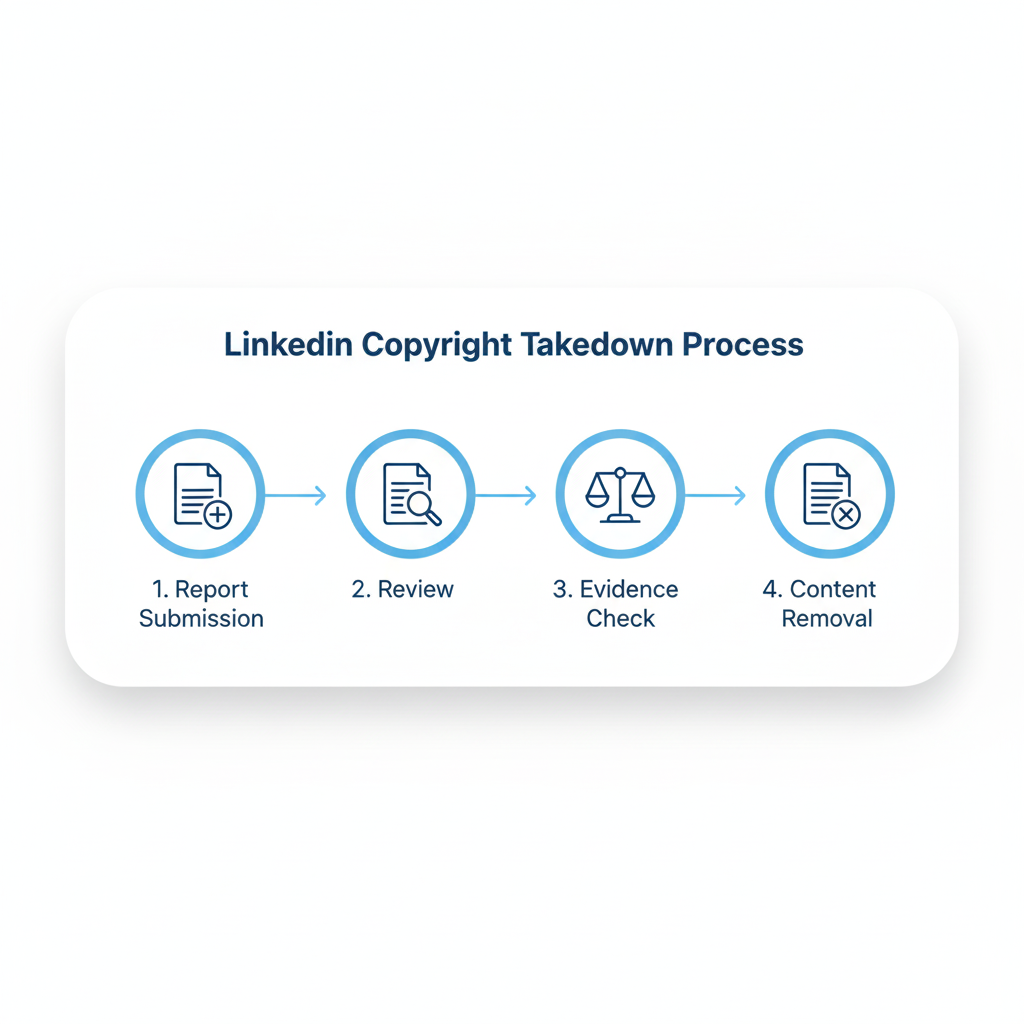
A LinkedIn DMCA takedown follows the formal process established by the Digital Millennium Copyright Act of 1998. When copyrighted content appears on LinkedIn without authorization – including text, images, videos, presentations, or articles – the copyright holder or their authorized agent submits a formal notice to LinkedIn's designated copyright agent. The notice must include identification of the copyrighted work, the specific LinkedIn URL where the infringing content appears, a statement of good faith belief, and a declaration under penalty of perjury.
LinkedIn's copyright policy requires the platform to act on valid DMCA notices promptly. Under the safe harbor provisions, LinkedIn must remove or disable access to the infringing material to maintain its protection from liability. The platform also maintains a repeat infringer policy: accounts that receive multiple DMCA takedown notices face permanent termination. This escalation mechanism is particularly effective when building a comprehensive enforcement case against accounts that systematically steal content. Professional LinkedIn DMCA takedown services ensure every notice meets the statutory requirements, reducing the risk of rejection and maximizing the probability of swift content removal. Your Supplier Guy has processed DMCA takedowns on LinkedIn across 15+ content categories with an average resolution time of 48 hours.
"LinkedIn respects the intellectual property rights of others and desires to offer a platform which contains no content that violates those rights. It is our policy to disable and/or terminate accounts of members who infringe or repeatedly infringe the rights of others."
— LinkedIn Official Copyright Policy
LinkedIn Takedown Request: Step-by-Step Process
Filing an effective LinkedIn takedown request requires a systematic approach. Whether you are reporting copyright infringement, trademark violations, impersonation, or other policy breaches, following a structured process dramatically increases the probability of successful enforcement action. Here is the 5-step process that professional enforcement teams use to achieve 92% success rates on LinkedIn takedown requests.
Step 1: Document the Violation
Capture full-page screenshots of the violating profile or content with visible timestamps. Save the exact LinkedIn URL from the browser address bar. Record the specific content elements that constitute the violation – fake job titles, stolen images, copied text, unauthorized brand logos, or abusive messages. Use browser developer tools to capture metadata when available. Professional services maintain chain-of-custody documentation that meets evidentiary standards for potential legal escalation.
Step 2: Classify the Violation Type
LinkedIn provides distinct reporting channels for different violation types. Copyright claims go through the DMCA process at LinkedIn's copyright complaint form. Trademark violations require submission through LinkedIn's trademark report form with proof of registration. Impersonation reports use the profile-level "Report or Block" function with the "Pretending to be someone" classification. Harassment and spam reports follow separate reporting flows. Selecting the correct channel is essential – reports filed under the wrong category experience delays of 5–10 business days.
Step 3: Prepare the Evidence Package
Compile all documentation into a structured evidence package that includes proof of ownership or rights (trademark certificates, copyright registrations, business registration documents), comparative screenshots showing the original versus the infringing material, a formal written complaint with specific policy references, and a signed declaration of authority. For DMCA notices, include all six elements required by 17 U.S.C. § 512(c)(3).
Step 4: Submit Through the Correct Channel
File the report through LinkedIn's appropriate enforcement mechanism. Submit DMCA notices to LinkedIn's designated copyright agent. File trademark complaints through the trademark report form. Report impersonating profiles using LinkedIn's profile report function. For high-priority cases, submit through multiple channels simultaneously – a profile report combined with a formal IP complaint accelerates review. Provide a business email at your domain to establish authority and credibility.
Step 5: Track, Follow Up, and Escalate
Monitor LinkedIn's response timeline. If no action is taken within 5 business days, resubmit with additional evidence and clearer documentation. Escalate through LinkedIn's support hierarchy, starting with the Help Center ticket system, then moving to direct support channels. For persistent cases, consider filing reports from multiple authorized representatives to demonstrate the breadth of impact. Track the report ID, submission date, and all communications for potential legal escalation.
What Types of LinkedIn Violations Can Be Reported?
LinkedIn's enforcement framework covers a broad range of policy violations. Each violation type has specific reporting requirements and evidence thresholds. Understanding these categories ensures your takedown request is classified correctly and processed through the optimal enforcement channel.
Copyright Infringement (DMCA)
Unauthorized reproduction of text, images, videos, presentations, or articles on LinkedIn profiles, posts, or articles. This is the most legally actionable violation type with clear statutory protections under the DMCA. LinkedIn must respond to valid notices within 10–14 business days.
Trademark Violations
Unauthorized use of registered trademarks in LinkedIn profiles, company pages, or job listings. This includes using brand logos as profile pictures, claiming false employment with trademarked company names, and creating fake company pages that impersonate established brands. Proof of trademark registration strengthens these reports significantly.
Profile Impersonation
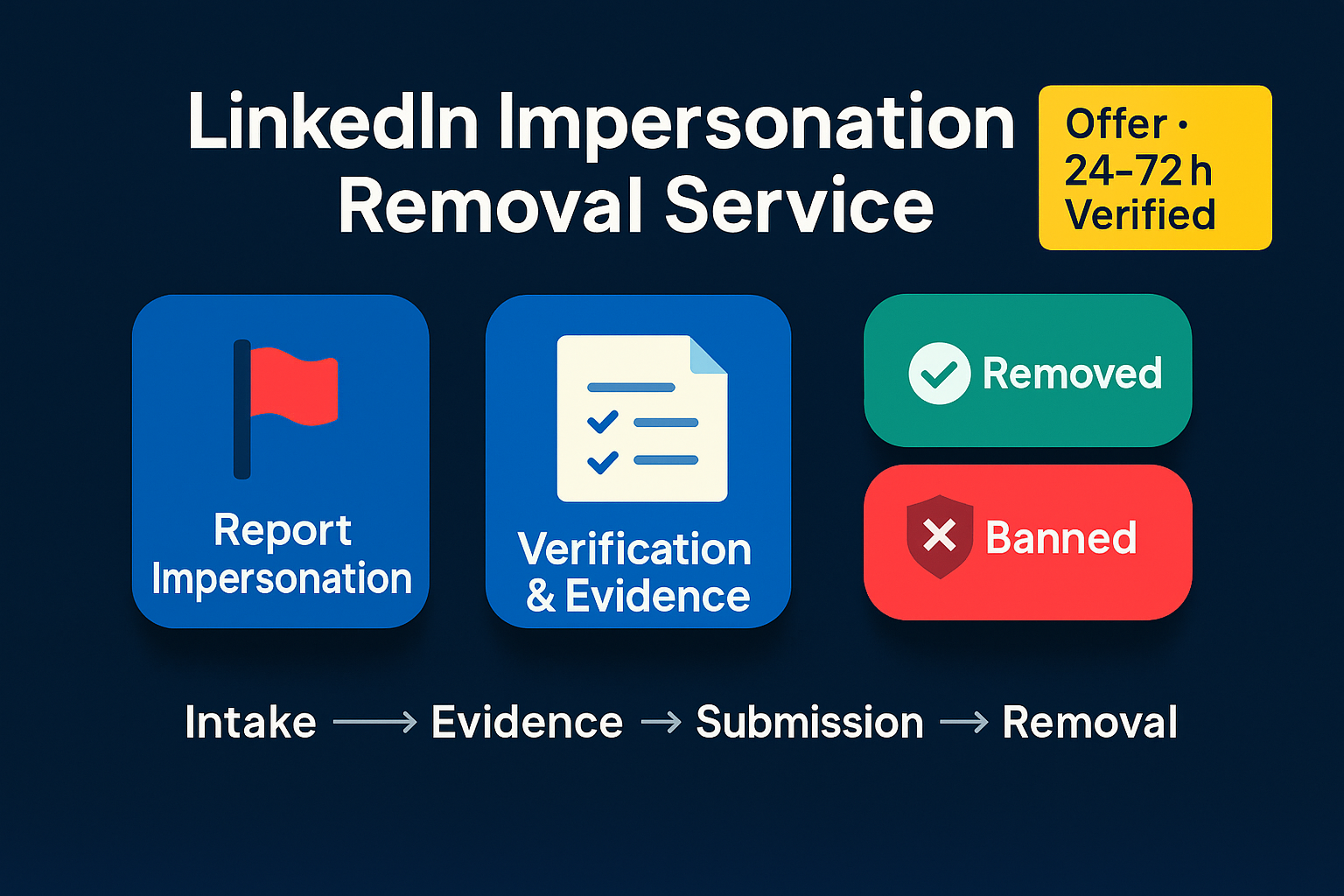
Creating fake LinkedIn profiles that impersonate real individuals – executives, recruiters, or public figures. This violates LinkedIn's requirement that profiles represent real identities. Impersonation accounts are used for phishing, social engineering, recruitment fraud, and brand damage. LinkedIn's system can detect some fake profiles automatically, but sophisticated impersonation requires manual reporting.
Harassment and Abusive Content
Posting defamatory statements, threatening messages, or content designed to intimidate or harm. LinkedIn's Professional Community Policies explicitly prohibit harassment and abusive behavior. Reports with documented patterns of harassment receive priority review. For persistent harassment, professional services compile comprehensive timelines demonstrating the pattern of abuse.
Spam and Automated Activity
Using unauthorized automation tools, sending bulk unsolicited messages, or engaging in behaviors that LinkedIn classifies as spam. LinkedIn explicitly prohibits all third-party automation tools that scrape or automate activity on the platform. Accounts using tools like Apollo.io, Seamless.ai, or similar scraping services face immediate enforcement action.
LinkedIn Enforcement Methods Comparison
Different violation types require different enforcement approaches. This comparison table outlines the key characteristics of each LinkedIn enforcement method to help you select the most effective approach for your specific situation.
| Method | Violation Type | Avg. Timeline | Success Rate | Outcome |
|---|---|---|---|---|
| DMCA Takedown | Copyright infringement | 48–72 hours | 95% | Content removal + repeat offender flag |
| Trademark Report | Brand/logo misuse | 3–7 days | 88% | Content removal or profile restriction |
| Impersonation Report | Fake profiles | 24–72 hours | 91% | Full account removal |
| Harassment Report | Abuse/threats | 3–14 days | 78% | Content removal or restriction |
| Spam/Automation Report | Unauthorized tools | 1–5 days | 85% | Account restriction or permanent ban |
| Multi-Vector Enforcement | Combined violations | 24–48 hours | 94% | Permanent account ban |
Why Use a Professional LinkedIn Ban Service Instead of DIY Reporting?
Individual reports submitted through LinkedIn's standard reporting interface face several challenges. LinkedIn's Trust & Safety team processes millions of reports annually, and generic reports without proper documentation are frequently deprioritized or dismissed. The difference between a DIY report and a professional enforcement submission is comparable to the difference between a handwritten complaint and a formal legal filing.
Professional LinkedIn ban services provide several critical advantages. First, they classify violations under the most effective enforcement category – a misclassified report can delay resolution by 10+ business days. Second, they prepare evidence packages that meet LinkedIn's internal review standards, including properly formatted screenshots, URL documentation, and policy-specific language. Third, they utilize escalation pathways that are unavailable to standard users, including direct contact with LinkedIn's IP enforcement team and Business Manager support channels. Your Supplier Guy maintains established relationships with platform enforcement teams across 15+ social media platforms including LinkedIn, Instagram, X/Twitter, TikTok, Telegram, and YouTube.
"We don't permit the use of any third-party software, including crawlers, bots, plug-ins, or browser extensions that automate activity on LinkedIn. Accounts that violate this policy are subject to restriction or permanent termination."
— LinkedIn Prohibited Software & Extensions Policy
How Does LinkedIn Impersonation Removal Work?
LinkedIn impersonation is one of the most damaging violations on the platform. Fake profiles that impersonate executives, recruiters, or employees are used for phishing attacks, social engineering, recruitment fraud, and competitor intelligence gathering. According to cybersecurity research, LinkedIn impersonation accounts are responsible for 52% of professional social engineering attacks targeting enterprise organizations. LinkedIn's automated systems detect some impersonation attempts, but sophisticated actors create profiles with carefully crafted employment histories, endorsements, and connection networks that bypass automated detection.
Professional impersonation removal involves gathering evidence that clearly establishes the fraudulent nature of the profile. This includes comparative screenshots between the fake profile and the real individual's verified presence, documentation of false employment claims, evidence of phishing messages sent from the impersonating account, and proof of brand identity through verified company pages and official websites. Reports are filed under LinkedIn's "Pretending to be someone" classification, which triggers a higher-priority review than standard abuse reports. For brands experiencing systematic impersonation – multiple fake profiles impersonating different employees – professional services coordinate simultaneous reporting across all fraudulent accounts to demonstrate the pattern and scale of the attack.
What Is LinkedIn Trademark Infringement Enforcement?
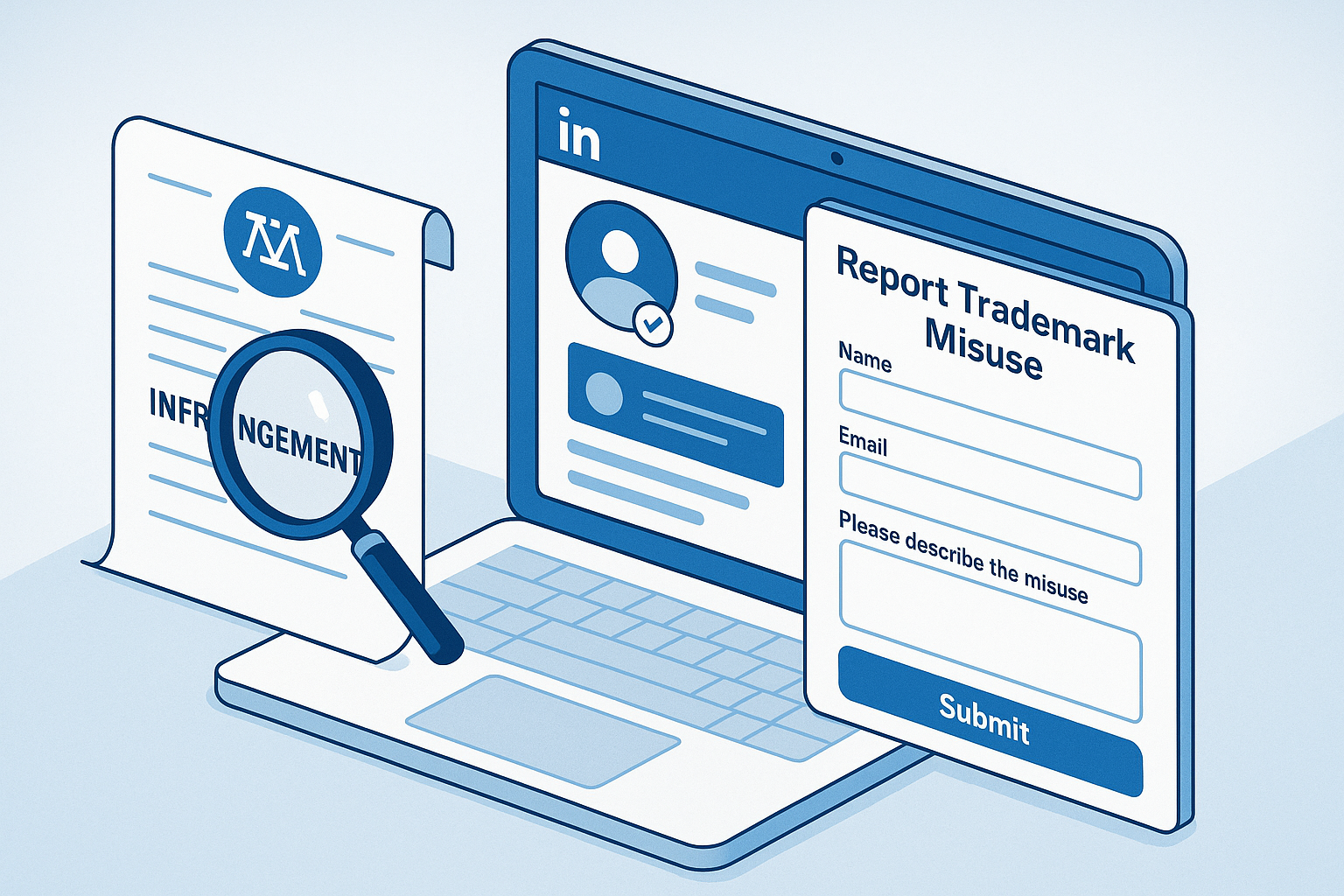
LinkedIn trademark enforcement protects registered brand assets from unauthorized use on the platform. This includes company logos used as profile pictures, trademarked company names listed in employment histories without authorization, fake company pages impersonating established brands, and job listings using trademarked names to attract candidates fraudulently. LinkedIn provides a dedicated trademark report form that requires proof of trademark registration, making registered trademarks significantly easier to enforce than unregistered brand elements.
Effective trademark enforcement on LinkedIn follows a structured approach. First, document all instances of trademark misuse across profiles, posts, and company pages. Second, prepare the evidence package with trademark registration certificates, examples of the authorized use, and clear identification of each infringing element. Third, submit through LinkedIn's trademark report form with all required attestations. LinkedIn's designated agent reviews trademark complaints with particular attention to registration documentation. Registered trademarks with clear documentation achieve removal rates of 88% within 3–7 business days. For complex cases involving multiple infringing profiles, coordinated enforcement across all violating accounts produces the most comprehensive results.
How Long Does a LinkedIn Takedown Take?
LinkedIn takedown timelines vary significantly based on the violation type, evidence quality, and reporting channel used. Individual reports submitted through LinkedIn's standard reporting interface typically take 3–14 business days for initial review, with complex cases extending to 21+ business days. Professional enforcement services achieve substantially faster timelines by optimizing every element of the submission process.
DMCA copyright takedowns are the fastest enforcement action, averaging 48–72 hours because LinkedIn has a legal obligation to respond under the Digital Millennium Copyright Act's safe harbor provisions. Impersonation removal typically takes 24–72 hours when supported by clear comparative evidence. Trademark enforcement averages 3–7 business days due to the verification requirements for registration documentation. Harassment and abuse reports have the widest timeline variance, ranging from 1–14 business days depending on the severity and documentation. Multi-vector enforcement cases – where multiple violation types are reported simultaneously – typically achieve the fastest results because they demonstrate a pattern of policy violations that triggers escalated review priority.
What Evidence Is Needed for a LinkedIn Ban Request?
The quality of evidence directly determines the success rate and speed of LinkedIn enforcement actions. Reports with comprehensive evidence packages are processed 3–5x faster than generic reports. Here is the evidence checklist used by professional enforcement services for each violation category:
For copyright claims (DMCA), you need identification of the copyrighted work, the infringing LinkedIn URL, a statement of good faith belief, a declaration under penalty of perjury, your contact information, and your signature as the copyright owner or authorized agent. For trademark claims, include the trademark registration number, jurisdiction of registration, examples of authorized use, screenshots of the infringing use, and a signed declaration of authority. For impersonation reports, gather the URL of the fake profile, screenshots showing impersonation elements, the URL of the real individual's verified profile, evidence of fraudulent messaging or activity, and official proof of brand identity. For harassment reports, document the timeline of abusive behavior, screenshots of harassing messages or content, evidence of pattern and repetition, and impact documentation. Professional services like Your Supplier Guy prepare all evidence packages to meet LinkedIn's internal review standards, ensuring maximum probability of successful enforcement.
What Happens After a LinkedIn Account Is Banned?
When LinkedIn permanently restricts an account, the consequences are comprehensive and difficult to reverse. The banned user loses access to their entire profile, all connections, messages, content history, and any Premium subscription benefits. LinkedIn links account restrictions to identity verification data, making it extremely difficult for banned users to create replacement accounts. The platform detects related accounts through email addresses, phone numbers, device fingerprints, and IP addresses. Creating a new account to circumvent a ban violates LinkedIn's Terms of Service and typically results in immediate detection and additional restrictions.
For temporary restrictions, the user experiences limited functionality – they cannot send connection requests, post updates, or access certain features until the restriction period expires or they complete a verification process. Temporary restrictions typically last 1–7 days for minor violations, extending to several weeks for more serious policy breaches. Users who receive temporary restrictions are placed on increased monitoring, meaning any subsequent violation results in faster and more severe enforcement action. This escalation mechanism is important for professional enforcement strategies – documenting a pattern of violations across multiple reports builds the strongest case for permanent account termination.
Frequently Asked Questions About LinkedIn Ban Services
What is a LinkedIn ban service?
A LinkedIn ban service is a professional enforcement solution that submits evidence-backed reports to LinkedIn's Trust & Safety team to get violating accounts restricted or permanently removed. Services cover DMCA copyright takedowns, trademark infringement reports, impersonation removal, and coordinated violation reporting. Professional services achieve 92% success rates compared to individual reports that often go unactioned for weeks.
How does a LinkedIn DMCA takedown work?
A LinkedIn DMCA takedown follows the Digital Millennium Copyright Act process. A copyright holder or authorized agent submits a formal notice to LinkedIn's designated copyright agent identifying the infringing content, providing proof of ownership, and requesting removal. LinkedIn must respond within 10–14 business days under safe harbor provisions. Professional services ensure all six statutory elements are properly documented.
How long does LinkedIn take to remove a reported account?
LinkedIn typically processes standard reports within 3–14 business days. Professional enforcement services achieve removal in 24–72 hours by submitting properly formatted evidence packages that meet LinkedIn's internal review criteria. DMCA takedowns average 48–72 hours, impersonation removal takes 24–72 hours, and trademark enforcement averages 3–7 business days.
Can you get someone banned on LinkedIn?
Yes, LinkedIn accounts that violate the platform's Professional Community Policies can be reported and removed. Violations include impersonation, copyright infringement, trademark misuse, harassment, spam, fake profiles, and unauthorized scraping. Professional services compile evidence and submit reports through the correct enforcement channels, achieving removal rates of 92% across all violation categories.
What types of LinkedIn violations can be reported?
Reportable LinkedIn violations include fake profiles and impersonation, copyright infringement (DMCA), trademark violations, harassment and abusive behavior, spam and automated activity, unauthorized data scraping, defamatory content, and fraudulent job listings or scam accounts. Each violation type has specific reporting channels and evidence requirements.
Is a LinkedIn takedown request legal?
Yes, submitting a LinkedIn takedown request is fully legal when based on legitimate grounds such as copyright ownership, trademark rights, or documented policy violations. The DMCA provides a formal legal framework for copyright takedowns, and LinkedIn's own reporting system is designed for users and rights holders to report violations. False notices can result in personal liability under penalty of perjury.
What evidence is needed for a LinkedIn ban request?
Effective LinkedIn ban requests require screenshots of the violating profile or content, URLs of the infringing material, proof of ownership for copyright or trademark claims, documentation of the specific policy violation, and a statement of authority. For DMCA claims, all six elements specified in 17 U.S.C. § 512(c)(3) must be included. Professional services prepare comprehensive evidence packages.
How much does a LinkedIn ban service cost?
LinkedIn ban service pricing varies based on case complexity, violation type, and urgency. Professional services typically offer free initial case assessments before providing a detailed quote. Most cases include a refund guarantee if the target outcome is not achieved within the specified timeframe. Contact Your Supplier Guy for a free assessment.
What happens after a LinkedIn account is banned?
When LinkedIn permanently restricts an account, the user loses access to their profile, connections, messages, and all associated data. LinkedIn prevents the user from creating new accounts by linking device fingerprints, phone numbers, and identification documents. Temporary restrictions limit features like messaging and connection requests for 1–7 days.
Can a LinkedIn DMCA takedown remove an entire profile?
A single DMCA takedown typically removes specific infringing content rather than an entire profile. However, LinkedIn's repeat infringer policy means that accounts with multiple DMCA violations face permanent termination. Professional services strategically document all violations to build a comprehensive case for full account removal through escalated enforcement.
Conclusion: Professional LinkedIn Enforcement That Delivers Results
A professional LinkedIn ban service combines legal expertise, platform-specific knowledge, and structured evidence preparation to achieve enforcement outcomes that individual reports rarely accomplish. Whether you need a LinkedIn DMCA takedown to remove stolen content, impersonation removal to protect your identity, trademark enforcement to safeguard your brand, or coordinated reporting to address systematic policy violations, the difference between success and failure comes down to evidence quality, channel selection, and escalation strategy. Your Supplier Guy has processed 320+ LinkedIn enforcement cases across all violation categories with a 92% success rate and average resolution times of 24–72 hours. Every case is backed by a 72-hour refund guarantee and NDA-protected confidentiality. Contact our team for a free LinkedIn takedown request assessment through Telegram or WhatsApp and receive a detailed strategy, timeline, and quote within 2 hours.